
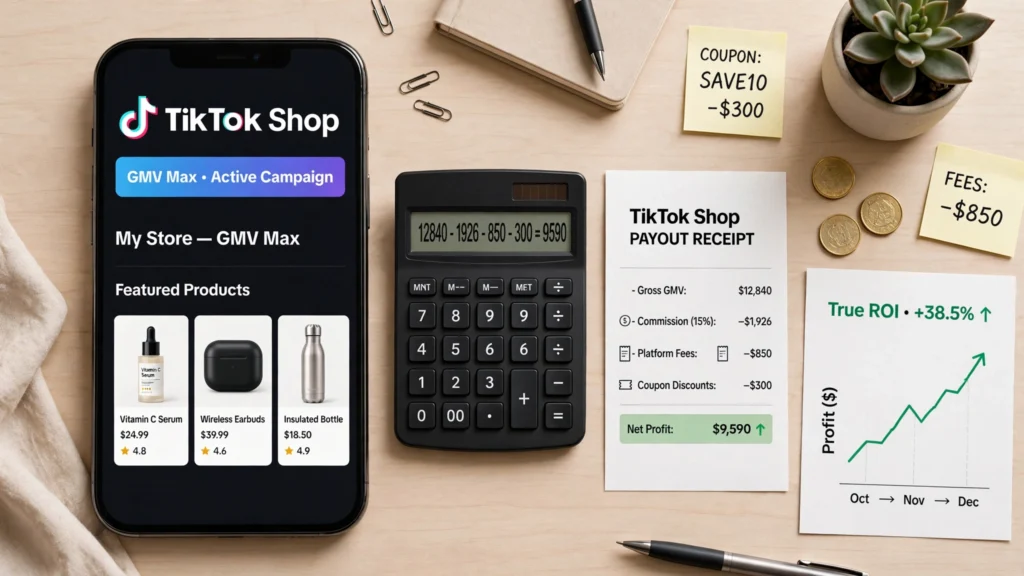
Your TikTok Shop dashboard says a campaign returned 4x. Your bank account disagrees. That gap is not a rounding error — it is the difference between gross revenue and true profit, and it is exactly what TikTok’s latest GMV Max update is trying to close.
On October 5, 2026, at Advertising Week New York, TikTok announced in its Newsroom that it is expanding GMV Max, its automated TikTok Shop ad solution, so it will further improve advertiser profitability by factoring in key business costs — like affiliate commissions, coupons, and referral fees — so advertisers can optimize for a true return on investment. Note TikTok’s own wording: this is an expansion that will factor in those costs, with no single rollout date given in the announcement. Secondary coverage in October and early November describes it starting with GMV Max Pro for some advertisers. Either way, the direction is clear — and smart sellers are not waiting for the rollout to fix their own math.
Interest is moving with it. In Google Trends (US, checked November 6, 2026), the TikTok Shop topic was up +180% in Rising topics under TikTok Ads over 90 days, +200% under TikTok Shop itself, and +90% under affiliate marketing. Searches for “tiktok shop black friday” were up +400% in 30 days. Sellers are heading into the biggest sales weeks of the year asking how TikTok Shop actually makes money. This guide gives you the math.
What GMV Max optimizes for — and what it used to miss
GMV Max is TikTok Shop’s automated campaign type. Instead of picking audiences and bids by hand, you set a budget and a target ROI, connect your shop products, and the system allocates spend across placements, creators, and formats to maximize gross merchandise value (GMV).
The problem was never the automation. The problem was the target. Classic GMV and ROAS count the sale price — they do not count what the sale cost you beyond ad spend:
- Affiliate commissions paid to creators who promoted the product, often 10–30% of the sale price
- Coupons and discounts you funded to close the sale
- Referral fees and platform fees TikTok Shop charges on the transaction
- Shipping subsidies, especially free-shipping offers you absorb
- Returns and refunds, which reverse revenue after the dashboard has already celebrated
If a creator earned 20% commission on a sale your ads also paid to acquire, a “profitable” 3x ROAS campaign could be break-even or worse. That is why TikTok’s move to factor affiliate commissions, coupons, and referral fees into GMV Max optimization matters: the algorithm can only protect a margin it can see.
The true ROI formula for TikTok Shop
Before you touch a single setting, calculate true ROI by hand for your best-selling product. You need one honest number per SKU.
True ROI = (Net revenue − all variable costs) ÷ ad spend
Work it in steps:
- Start with net revenue. Sale price minus refunds and cancellations for the period — not gross orders.
- Subtract product cost. Your landed cost per unit, including inbound freight.
- Subtract platform costs. TikTok Shop referral fee plus any transaction fees.
- Subtract affiliate commissions. Use the actual commission rate paid on attributed sales, not your headline rate.
- Subtract coupon costs. The discount amount you funded, averaged across all orders (including full-price ones).
- Subtract shipping subsidy. What free or discounted shipping actually cost you per order.
- Divide the remainder by ad spend. That is the return your GMV Max target has to beat.
A worked example
Say a product sells for $40. In a typical week:
- Product cost: $12
- Referral/platform fees: $2.40 (6%)
- Affiliate commission at 20%: $8
- Average coupon cost: $2
- Shipping subsidy: $3
- Refund rate adjustment: $1.20 (3%)
Total variable cost before ads: $28.60. Contribution per order: $11.40 — a 28.5% contribution margin. If your GMV Max campaign reports a 3.5x ROAS, your ad cost per order is about $11.43. You are, almost exactly, breaking even — while the dashboard looks like a win. To earn a real 20% profit on ad spend, you would need a target closer to 4.2x on this SKU, or you need to change the economics: lower commission tier, smaller coupon, or a higher price.
Run this math per product, not per shop. A hero product with a 45% contribution margin and a loss-leader at 15% cannot share one ROI target.
How to set GMV Max targets that protect profit
1. Segment by margin, not by catalog
Group products into margin bands — for example, high (40%+ contribution), mid (25–40%), and thin (under 25%). Run separate GMV Max campaigns per band, each with its own ROI target. Thin-margin products need much higher targets or should be excluded from paid promotion and left to organic and affiliate traffic, where there is no ad spend on top of commission.
2. Set the target from your break-even, then add your profit goal
Your break-even ROAS is 1 ÷ contribution margin. At a 28.5% margin, break-even is about 3.5x. Decide the profit you require — say, profit equal to 25% of ad spend — and set the target above break-even accordingly. If you set targets below break-even because “volume will fix it,” volume will simply scale the loss.
3. Count affiliate cost once — and in the right place
The most common mistake: a sale is attributed to both a GMV Max campaign and an affiliate creator, and the seller charges full commission and full ad cost without checking attribution. As GMV Max begins factoring commissions into optimization, verify which sales carried both costs. Commission is a cost of that specific order, not a monthly lump to spread evenly.
If affiliate creators drive a large share of your sales, protect the relationship side of the funnel too. Creators promote products that pay reliably and convert. The landing experience and follow-up behind your shop matter — if you also sell through your own store or lead funnel, a simple system that captures email and follows up will outperform a patchwork of tools. That is the use case for an all-in-one platform like Systeme.io (affiliate link — I may earn a commission at no extra cost to you), which I reviewed in my Systeme.io review — you can start on its free plan here.
4. Reprice coupons as an ad cost
A $5 coupon that lifts conversion 20% may be cheaper than the extra ad spend needed for the same lift — or it may not. Treat coupon spend as media spend: track cost per order with and without the coupon active, and never stack a deep coupon on top of a high affiliate commission during Black Friday unless the combined math still clears your target. With “tiktok shop black friday” searches up +400%, the temptation to stack every incentive at once is exactly how margins disappear in November.
5. Reconcile weekly against payouts, not dashboards
Once a week, compare three numbers: dashboard GMV, TikTok Shop payout statements, and your bank deposits. The payout statement is where referral fees, commissions, shipping adjustments, and refunds become real. If your true ROI calculation and the payout disagree, trust the payout and find the missing cost line.
What to do while the GMV Max true-ROI expansion rolls out
TikTok has announced the direction, not a universal switch-on date. Do not wait:
- Audit your top 10 SKUs this week using the formula above.
- Split campaigns by margin band before Black Friday traffic peaks.
- Brief your affiliates. If commissions are factored into ad optimization, creators promoting low-margin products may see less paid support. Offer tiered commissions that keep hero products attractive to promote.
- Watch delivery. If a campaign suddenly spends differently, check whether cost factoring has reached your account before assuming a performance problem — see my guide on why TikTok ads are not delivering.
- Reuse your best creative formats. See my TikTok carousel ads setup guide and AI strategies for TikTok Ads.
Common mistakes that make GMV Max look better than it is
- One ROI target for the whole shop. Averages hide losing SKUs behind winners.
- Ignoring returns. A 10% return rate is a 10% revenue cut that arrives weeks later.
- Paying commission and ads on the same order without a plan. Sometimes that stack is worth it for ranking and social proof — but decide it, do not discover it.
- Judging by ROAS alone. ROAS measures revenue efficiency, not profit. A lower-ROAS campaign on a high-margin product can be your most profitable one. For a wider comparison, see Facebook Ads vs TikTok Ads.
Bottom line
GMV Max is getting smarter about the costs that decide whether a TikTok Shop sale makes money — affiliate commissions, coupons, and referral fees. But the algorithm can only optimize the economics you give it. Calculate true ROI per product, segment by margin, set targets above real break-even, and reconcile against payouts weekly. Then dashboard and bank account will finally tell the same story.
This article contains an affiliate link to Systeme.io. If you sign up through it, I may earn a commission at no additional cost to you. I only link to tools I have reviewed on this site. Nothing in this article guarantees sales or profit — results depend on your products, margins, and execution.